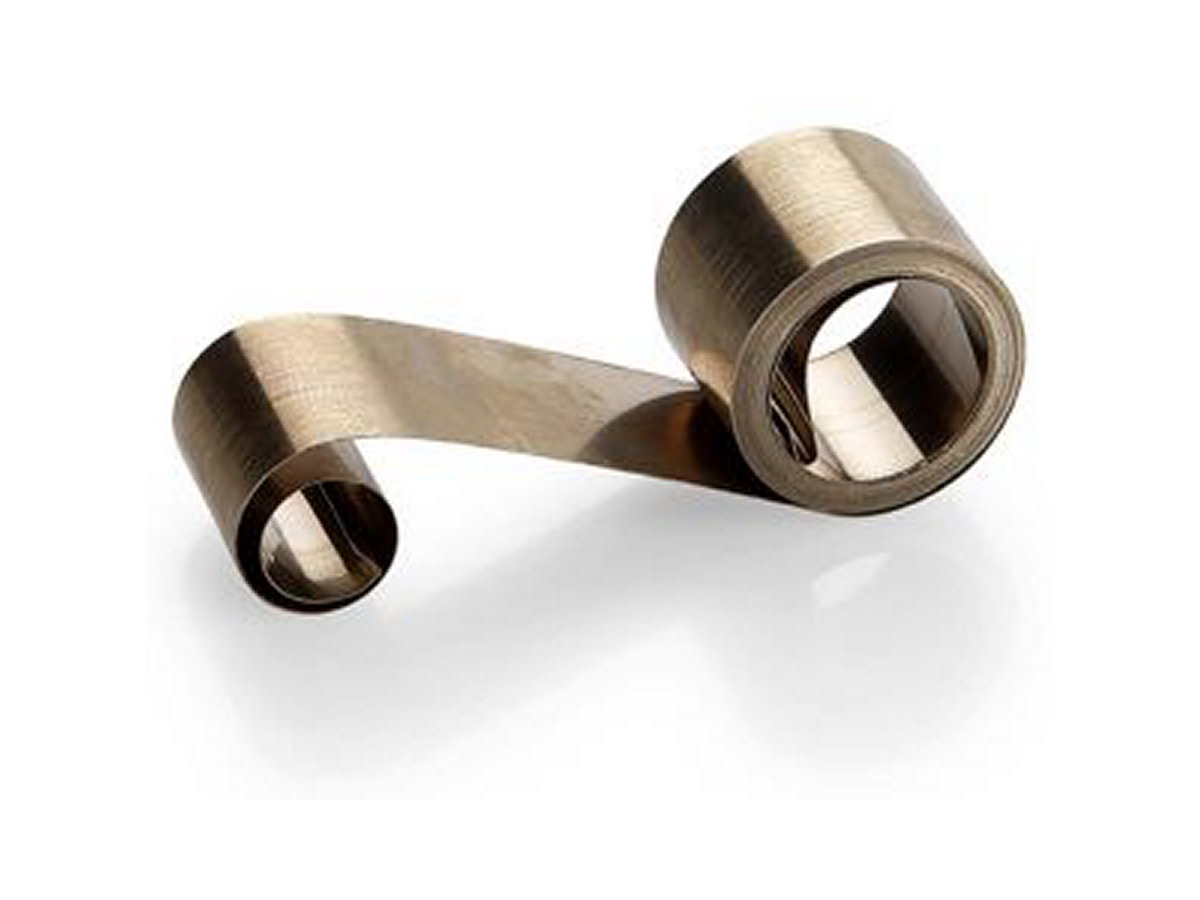
Constant Force Springs
A constant force spring is a pre-stressed flat strip coiled tightly on itself. When the strip is extended, it delivers a nearly constant force over a long travel, which makes it useful for counterbalances, cable and hose retractors and position-holding mechanisms.
Product Overview and Project Fit
Custom constant force springs for counterbalance, cable retraction and motion control over long travel. Strip size, force and life reviewed per project.
Constant force springs deliver nearly constant output over long travel for retraction, counterbalance, and motion-control mechanisms.
- Long Life
- Compact
- Custom Ends
Applications
- Machinery
- Electronics
Processes
- Cold Coiling Process
- Testing
How constant force springs work
Why the force stays nearly constant
A constant force spring is a strip of spring material pre-stressed so that its natural state is a tight coil. When the strip is pulled out, only the short section leaving the coil is being straightened at any moment. The force needed to straighten it depends on the strip width, thickness and natural coil radius, not on how much strip is already extended, so the force stays nearly flat over the travel while the coil rotates on a drum or in a cavity.
The force builds to its working value over the first part of the extension — typically about 1.25 times the coil diameter — and then stays close to constant.
What sets force and life
Force rises with strip width and roughly with the cube of strip thickness, and falls with the square of the natural coil radius. The bending stress in the strip rises with the ratio of thickness to coil radius, and that stress decides cycle life. A design for longer life therefore uses a thinner strip or a larger coil, usually with a wider strip to recover the force.
Standard catalog springs are often rated around 2,500 cycles. Designs for 10,000 cycles or more are made by lowering stress for the same force, and the target life is agreed with the drawing.
Mounting methods
How the coil is supported changes friction, force stability and life:
- Drum mounting — the coil rides on a drum or bushing about 10–20% larger in diameter than the spring’s natural inside diameter, so it turns freely.
- Cavity mounting — the coil floats in a pocket; simple, but with more friction.
- Back-to-back or A-frame mounting — two coils share one strip end to double the force without doubling the width.
- Strip end attachment — hole, slot, tab or rivet, specified on the drawing.
Typical applications
Constant force springs suit long, steady motion in a small space:
- Counterbalancing sash windows, monitor arms, medical carts and vertical doors or covers.
- Retracting cables, hoses and tapes.
- Carbon brush holders in motors and generators, where the spring keeps brush pressure steady as the brush wears.
- Position holding in furniture, displays and product pushers.
Constant force spring materials
Strip material is chosen for force density, corrosion and cost:
- 301 stainless steel — the most common choice, combining high strength with corrosion resistance.
- High-carbon spring steel strip — lower cost; needs corrosion protection.
- Other stainless grades or special alloys when temperature or the environment requires them.
Drawing inputs to confirm
Use these family-specific inputs to prepare a drawing review covering geometry, service conditions and acceptance. Final parameters are agreed for your project.
- Strip thickness/width, spool geometry and mounting arrangement
- Required force-versus-travel curve and measurement points
- Usable stroke, cycle-life target, environment and acceptance method
FAQ
How constant is the force of a constant force spring?
The force is close to constant after the first part of the extension, but it varies with strip thickness, coil diameter, drum size and cycle life. Force tolerance and life are agreed per drawing.
How do constant force springs work?
The strip is pre-stressed so that its natural shape is a tight coil. Pulling the strip out straightens the section leaving the coil, and the force needed to straighten it depends on strip width, thickness and natural coil radius rather than on how far the strip has been pulled, so the force stays nearly flat along the travel.
What is the difference between a constant force spring and a power spring?
A constant force spring is pulled out in a straight line and gives a nearly constant linear force. A power (clock) spring is a spiral strip wound inside a housing that delivers torque, and its torque changes with the number of turns wound or released.
Related Articles and Selection Guides
Contact Us
Share your drawing, working load, material and quantity. We will help define the next step toward a manufacturable spring.