Capability
Explore cold and hot coiling, finishing and inspection capabilities. Material, load, fatigue-life targets and acceptance requirements are reviewed for each application.
Capability Envelope and Key Parameters
Use the forming ranges as a starting point. Material, geometry and service conditions determine the next review steps.
- Automatic Cold Coiling: Our cold-coiling window covers wire diameters from 0.1 mm to 10 mm for compression, extension, torsion, wire forms, and other precision elastic parts.
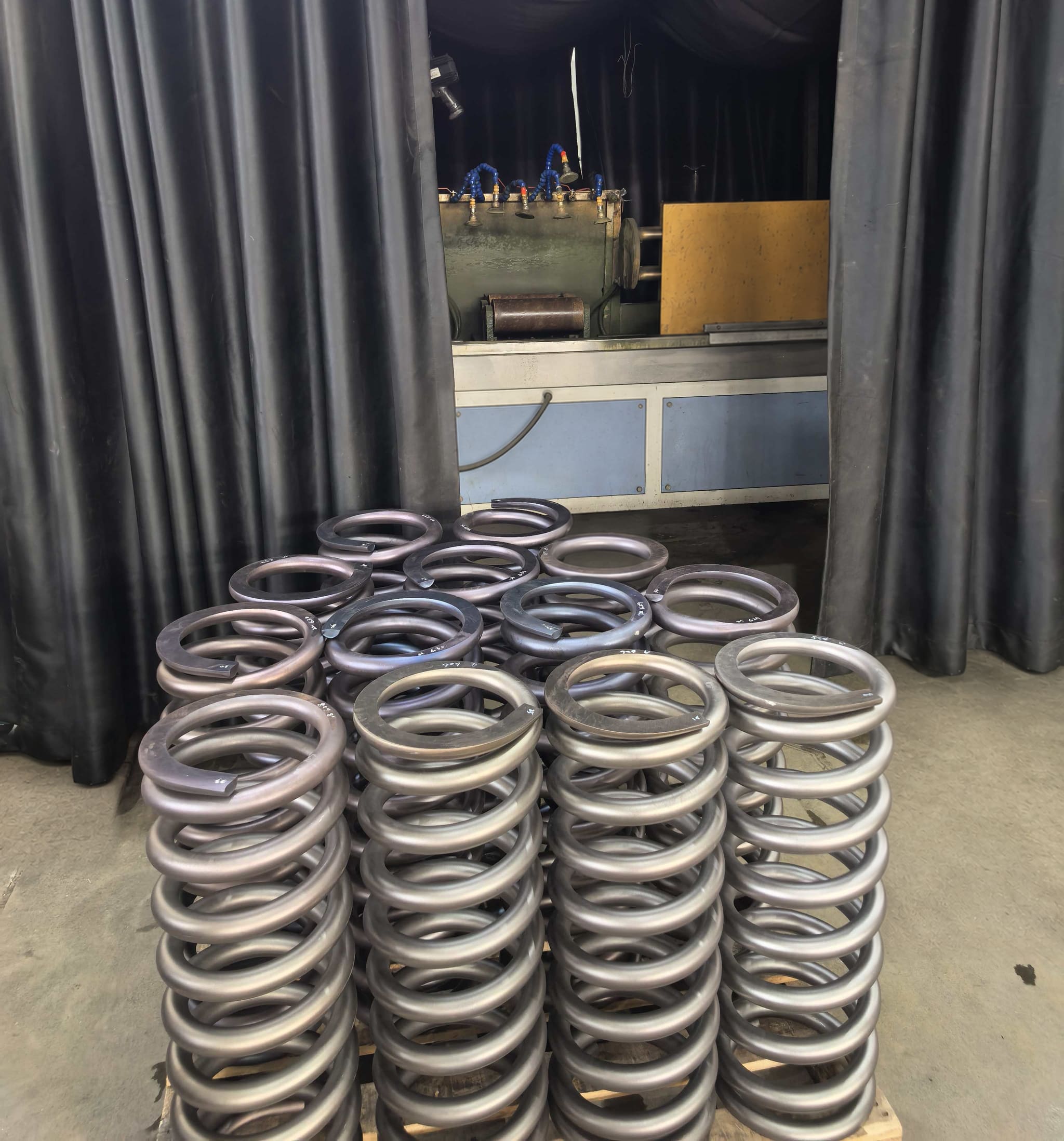
- Medium-Freq. Hot Coiling: The highlighted hot-coiling window covers large-wire diameters from 14 mm to 50 mm for heavy-duty springs used in power equipment, heavy machinery, and demanding buffer applications.
- Standards Reference (GB / ISO / JIS): GB, ISO and JIS are reference systems. The specific standard, edition and acceptance criteria are agreed for each drawing and application.
- 5-50 tonf: Patent CN103604590B describes a spring strength and fatigue test rig designed for 5–50 tonf. Project test feasibility, fixtures and current equipment availability require confirmation.
Production Process
- Cold Coiling Process: The stated cold-coiling capability covers approximately 0.1–10 mm wire. Product geometry, material and achievable tolerances are confirmed during drawing review.
- Hot Coiling Process: Induction heating supports large-wire hot coiling for heavy industrial applications. Heating and heat-treatment conditions are selected for the material and required properties.
Quality Control
Agree what is measured, under which conditions, and which records accompany the delivery.
- NDT & Load Testing: Magnetic particle inspection for suitable materials and load/displacement checks can be specified in the quality plan. Test coverage and sampling are agreed per project.
- Quality Plan & Documentation: Agree the applicable quality documents, traceability records, sampling and acceptance criteria during supplier qualification. Current certificate scope and validity require documentary confirmation.
Products
- Heavy Duty Compression Springs, Hot Coiled — A hot coil spring is a helical spring wound from steel bar that has been heated, typically to about 850–950 °C, so that large diameters can be formed, and then quenched and tempered.
- Stacked Disc Spring Assemblies — A disc spring stack is a set of conical disc springs (Belleville washers) arranged in series to increase deflection, in parallel to increase load, or in combination to tune the load–deflection curve.
- Die Springs — A die spring is a heavy duty compression spring wound from rectangular (flat-sided) wire.
- Compression Springs — A compression spring is an open-coil helical spring that resists a compressive load and pushes back as it is shortened.
- Extension Springs — An extension spring is a close-wound helical spring that resists pulling.
- Torsion Springs — A torsion spring is a helical spring loaded by rotating its legs about the coil axis; it stores energy as torque rather than axial force.
- Wave Springs & Wave Spring Washers — A wave spring is a compression spring made from flat wire formed with waves around its circumference.
- Contact Springs — A contact spring maintains a defined contact force between conductive parts so that electrical resistance stays stable as parts wear, heat up or vibrate.
- Retaining Rings, Snap Rings & Circlips — A retaining ring — also called a circlip or snap ring — is a spring-steel fastener that sits in a groove to locate parts axially on a shaft (external ring) or in a bore (internal ring).
- Custom Wire Forms & Wire Forming — A wire form is a part bent from spring or carbon wire into a functional shape — clips, hooks, brackets, levers or spring-loaded retainers — rather than a uniform coil.
- Constant Force Springs — A constant force spring is a pre-stressed flat strip coiled tightly on itself.
- Garter Springs — A garter spring is a long close-coiled spring joined end to end to form a ring.
- Flat Springs — A flat spring is formed from strip or sheet rather than round wire.
- Power / Clock Springs — A power spring, also called a clock spring or motor spring, is a flat strip wound into a spiral, usually inside a housing.
- Variable Force Springs — A variable force spring is a strip spring whose force changes in a designed way as it is extended — rising or falling along the travel — usually by tapering the strip width or thickness.
- Spiral Springs — A spiral spring, or flat spiral torsion spring, is a strip wound in a plane with space between the coils.
- Contact Clips / Leaf-Type Elastic Parts — Contact clips are stamped or formed spring parts — leaf springs, battery contacts, grounding clips and spring clips — that clamp, latch or conduct current.
- Multi-Turn Wave Spring Assemblies — A multi-turn wave spring stacks several waved turns of flat wire crest-to-crest in one continuous coil.
- Belleville Spring Washers & Disc Springs — A disc spring, also called a Belleville washer or Belleville spring, is a conical annular disc that flattens under axial load.
Start with a reviewable project brief.
A drawing or sample starts the discussion. Add the operating conditions and acceptance requirements so the team can assess the next step.