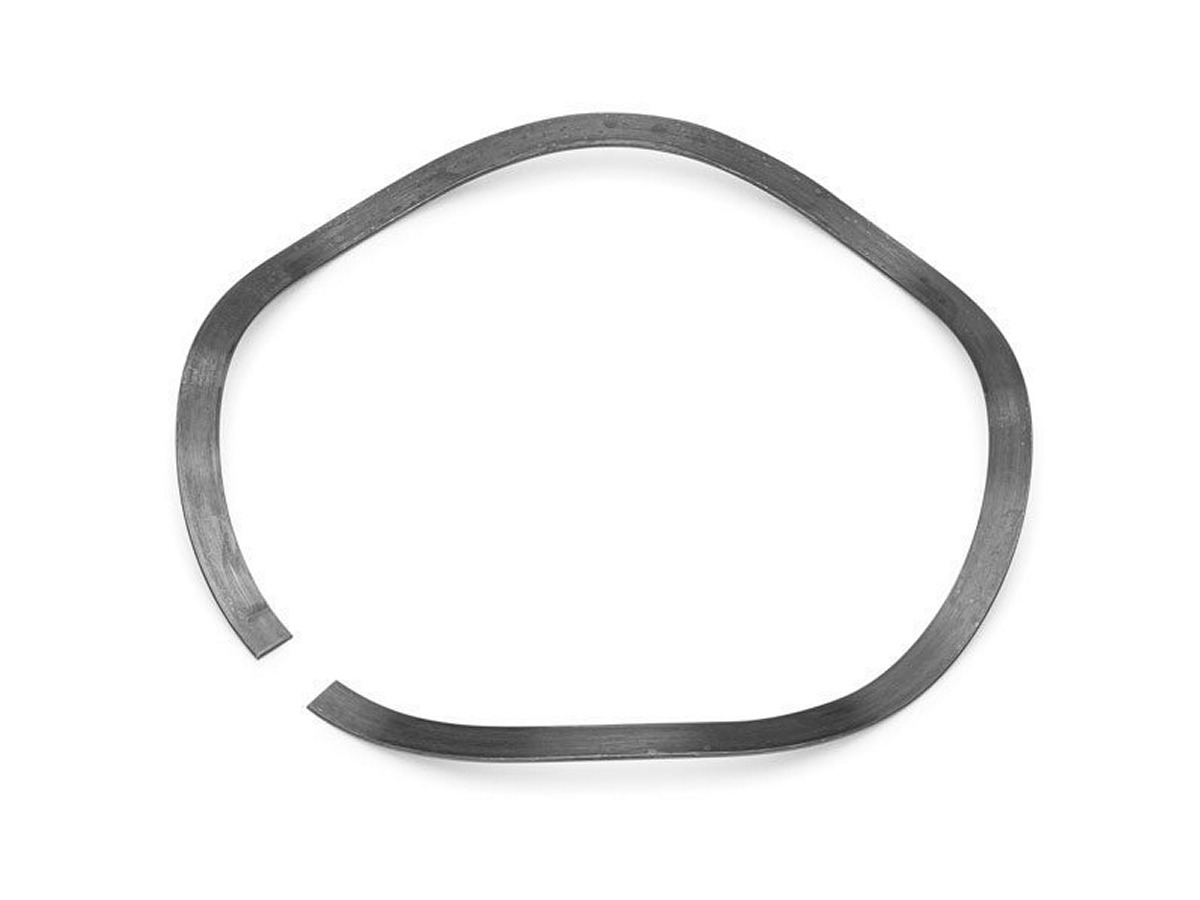
Wave Springs & Wave Spring Washers
A wave spring is a compression spring made from flat wire formed with waves around its circumference. Because the load is carried by the wave crests, a wave spring can reach a given load in a shorter working height than a round-wire coil spring. Single-turn wave spring washers are widely used for bearing preload and axial play compensation.
Product Overview and Project Fit
Single-turn wave spring washers and compact wave springs for bearing preload and tight axial space. Waves, free height and load reviewed per assembly.
Single-turn or multi-turn wave springs for limited axial space, preload control, bearing preload, and compact precision assemblies.
- Compact
- High Precision
- Long Life
Applications
- Electronics
- Machinery
Processes
- Cold Coiling Process
- Testing
Wave spring and wave washer design guide
Types of wave springs
All wave springs are formed from flat wire or strip with waves around the circumference. They differ in how many turns are used and how the turns are stacked.
- Single-turn wave washers — one waved ring with a gap or overlapping ends; low load and very short deflection, mainly for bearing preload and taking up axial play.
- Multi-turn crest-to-crest wave springs — one continuous flat wire whose crests rest on the troughs of the next turn, giving coil-spring-like deflection in less height.
- Nested wave springs — turns stacked in phase so the load multiplies at the same deflection, much like disc springs stacked in parallel.
- Wave springs with shim ends — flat end turns that spread the load and seat squarely against the mating faces.
Why wave springs save axial space
In a round-wire coil spring the solid height is the number of coils times the wire diameter. A flat-wire wave spring carries the load through its wave crests, so the same load and deflection can usually be reached in a shorter working height; manufacturers commonly quote operating-height reductions of up to about 50%.
The trade-offs are a higher part cost, less practical deflection and a load that rises more steeply as the spring approaches solid height.
What sets the load of a wave washer
For a single-turn wave washer the load at a given deflection rises with the radial width of the strip, with the cube of its thickness and with the fourth power of the number of waves, and falls with the cube of the mean diameter. Small changes in thickness or wave count therefore move the load a long way, which is why thickness tolerance and wave forming are controlled closely.
Bearing preload with wave washers
A wave washer placed against the outer ring of a ball bearing removes axial play, lowers noise and vibration and keeps the bearing loaded as parts expand with temperature. The preload is the washer load at its installed height, so the tolerance stack of the housing shoulder, bearing width and cover decides how much preload varies. Check the load at the minimum and maximum installed height, not only at nominal.
Wave spring materials
Material is chosen for stress, temperature and corrosion exposure:
- Carbon spring steel flat wire — general industrial use with a protective finish.
- 17-7PH (1.4568) precipitation-hardening stainless — corrosion resistance with high strength and better temperature tolerance.
- 302 / 316 stainless — corrosive or low-magnetic applications at lower stress.
- Nickel alloys such as Inconel X-750 — high-temperature service.
What to specify for a custom wave spring
A quotation needs enough to fix the space, the load and the life:
- Bore diameter and/or shaft diameter, and which one guides the spring.
- Working height or heights, with the load required at each.
- Maximum free height and the minimum height the spring may be compressed to.
- Cycle life, operating temperature, environment and any finish requirement.
Drawing inputs to confirm
Use these family-specific inputs to prepare a drawing review covering geometry, service conditions and acceptance. Final parameters are agreed for your project.
- Outside/inside diameter, material thickness/width and wave geometry
- Installed height, force points and available travel
- Wave count or turn/layer count, mating surfaces and inspection tolerances
FAQ
Wave spring vs coil spring — when should I use a wave spring?
Choose a wave spring when axial space is limited and the load is moderate and well defined, such as bearing preload or seal loading. A round-wire coil spring is usually simpler and lower cost when length is available or larger deflection is needed.
What is a wave spring washer?
A wave spring washer is a single ring of flat spring steel formed with several waves. Pressed flat between two faces it acts as a short-stroke spring, so it is used to preload bearings, take up axial play and keep light, steady pressure on a part where there is no room for a coil spring.
How many waves should a wave spring washer have?
Common wave washers have three to six waves. More waves raise the load and spread it over more contact points but leave less deflection, so the wave count is chosen together with strip thickness to reach the target load at the installed height.
Related Articles and Selection Guides
Contact Us
Share your drawing, working load, material and quantity. We will help define the next step toward a manufacturable spring.