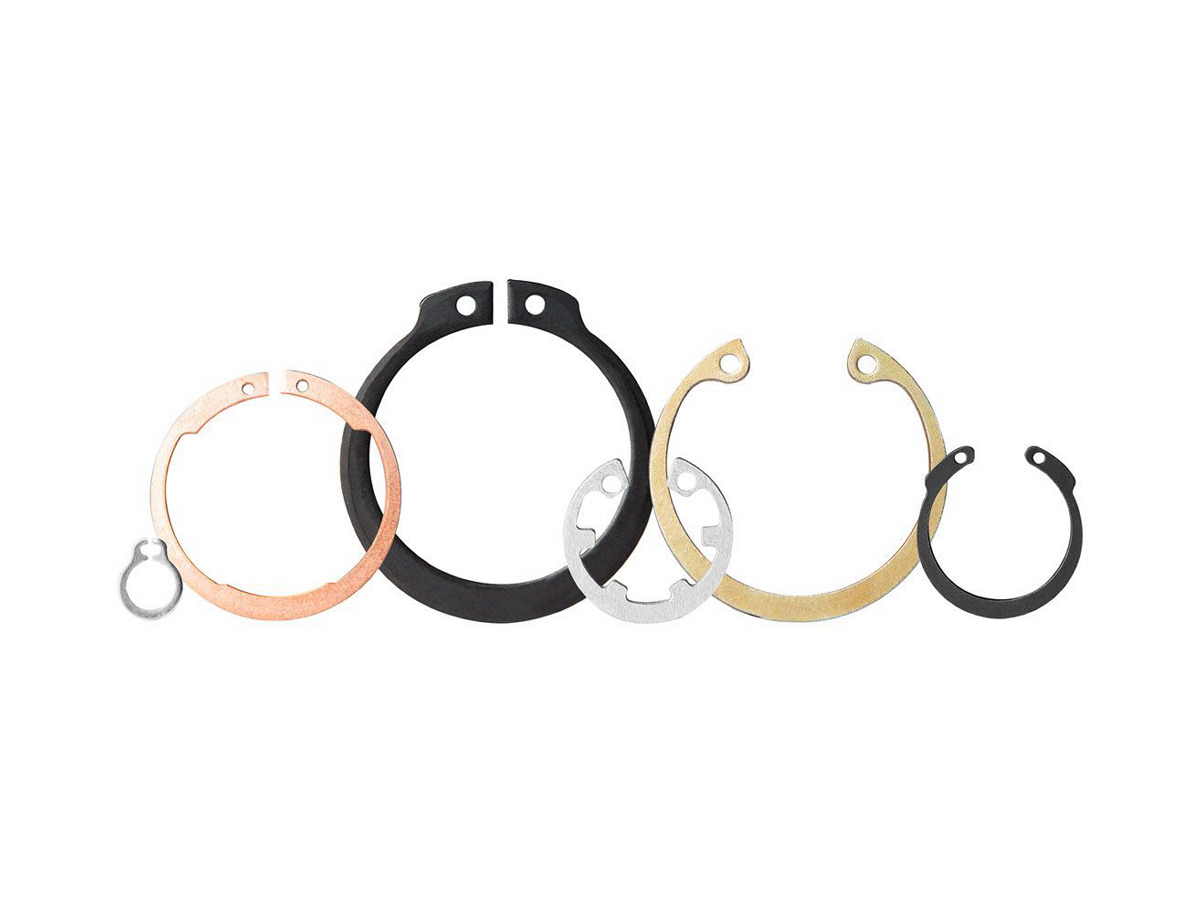
Retaining Rings, Snap Rings & Circlips
A retaining ring — also called a circlip or snap ring — is a spring-steel fastener that sits in a groove to locate parts axially on a shaft (external ring) or in a bore (internal ring). Its holding capacity depends on the ring section, groove geometry, material and load direction.
Product Overview and Project Fit
Custom retaining rings, snap rings and circlips: internal retaining rings for bores, external rings for shafts, spiral retaining rings. Groove fit reviewed.
Retaining rings and snap rings for axial positioning, load retention, and installation locking, available in custom sizes and groove-fit styles.
- High Durability
- Anti-rust
- Small Batch
Applications
- Machinery
- Automotive
Processes
- Cold Coiling Process
- Testing
Retaining ring and circlip guide
Circlip, snap ring or retaining ring?
"Retaining ring" is the general term used in most standards and catalogs. "Circlip" is the usual British and European name for the tapered-section ring with lug holes defined by DIN 471 (shafts) and DIN 472 (bores). "Snap ring" is often used in North America for any ring that snaps into a groove. All of them locate a part axially by sitting partly in a groove and partly above it, where the exposed section forms a shoulder.
Internal, external and spiral retaining ring types
The choice depends on direction of assembly, space around the groove and thrust load:
- External retaining rings (DIN 471 circlips) — for shafts; expanded with circlip pliers through the lug holes and released into the shaft groove.
- Internal retaining rings (DIN 472 circlips) — for bores; compressed with pliers and released into the housing groove.
- DIN 6799 E-clips (retaining washers) — pushed radially onto a shaft groove where there is no axial access.
- Spiral retaining rings — wound from flat wire with no lugs, giving a full 360° shoulder with no gap.
- Wire snap rings — formed from round or shaped wire; low cost, with a lower thrust capacity.
Why DIN 471 and DIN 472 rings have a tapered section
The radial width of a circlip narrows from the lugs toward the free ends. This tapered section lets the ring stay round when it is expanded or compressed for installation, so it seats evenly in the groove and bears on the groove wall all the way round instead of only near the lugs.
Groove design and thrust load
Axial holding capacity is limited by whichever fails first: the ring shearing, the ring dishing out of the groove, or the groove wall yielding. On soft shafts and housings the groove, not the ring, often sets the limit, so groove depth, the margin from the groove to the shaft end, corner radius and the hardness of the grooved part all matter.
A retained part with a sharp corner that sits close to the ring raises the allowable load. A large chamfer or radius on the retained part lowers it, because the load then acts further out on the ring and makes it dish.
Materials and finishes
Rings are hardened and tempered so they spring back into the groove after installation:
- Carbon spring steel such as C75S (1.1248) or C67S — the standard choice for DIN 471 and DIN 472 rings.
- Stainless steel such as 1.4122 or 1.4310 — for wet or corrosive environments.
- Phosphate and oil, black oxide or zinc-based finishes; plated high-strength rings are baked to reduce the risk of hydrogen embrittlement.
What to send for a custom retaining ring
A drawing or the following data lets the ring and groove be checked together:
- Shaft or bore diameter, groove diameter and groove width.
- Thrust load, whether it is static or impact, and the material and hardness of the grooved part.
- Shaft speed for external rings, since high speed can lift a ring out of its groove.
- Environment, finish and installation method — hand pliers or automated assembly.
Drawing inputs to confirm
Use these family-specific inputs to prepare a drawing review covering geometry, service conditions and acceptance. Final parameters are agreed for your project.
- Shaft or bore diameter and the complete groove dimensions
- Installation direction, assembly clearance and axial retention load
- Material, installation method and retention inspection criteria
FAQ
What is the difference between internal and external retaining rings?
An external retaining ring is expanded to pass over a shaft and snaps into a shaft groove; an internal retaining ring is compressed to enter a bore and expands into a housing groove. The lug or plier-hole design differs accordingly.
What is a spiral retaining ring?
A spiral retaining ring is edge-wound from flat wire, typically in two or three turns. It has no lugs and no gap, so it bears on the groove wall all the way round and leaves no lugs to interfere with mating parts; it is wound into the groove and removed from its notched end. Spiral rings suit compact assemblies and bores or shafts where lugs would get in the way.
What is the difference between a circlip and a snap ring?
In practice the terms overlap. "Circlip" usually means the tapered-section ring with plier holes in its lugs, as in DIN 471 and DIN 472. "Snap ring" is a broader, mainly North American term for any ring that snaps into a groove, including constant-section wire rings without lugs.
How do I choose the right circlip size?
Start from the nominal shaft or bore diameter; the DIN 471 and DIN 472 tables then give the groove diameter, groove width and ring thickness for that size. Check that both the ring and the groove carry the thrust load and, for external rings on rotating shafts, that the speed stays within the ring’s permissible limit.
Related Articles and Selection Guides
Contact Us
Share your drawing, working load, material and quantity. We will help define the next step toward a manufacturable spring.