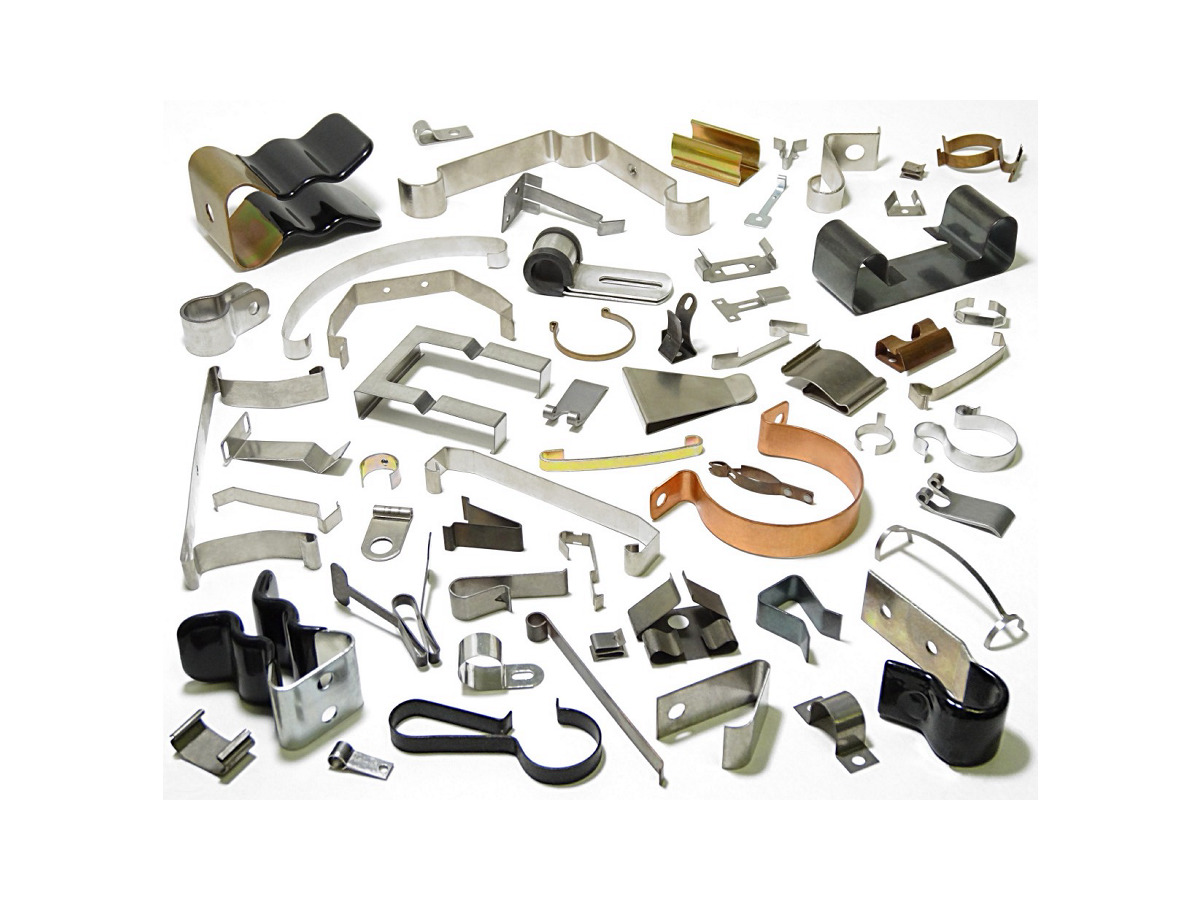
Flat Springs
A flat spring is formed from strip or sheet rather than round wire. It deflects by bending and provides force in compact spaces such as latches, brush holders, clamps and electrical contacts.
Product Overview and Project Fit
Custom flat springs from spring-steel or copper-alloy strip for latches, contacts and compact mechanisms. Thickness, form and force reviewed per drawing.
Precision elastic components formed from strip or sheet material, suitable for electrical contacts, latching mechanisms, and compact assemblies.
- High Precision
- Anti-rust
- Small Batch
Applications
- Electronics
- Machinery
Processes
- Surface
- Testing
Flat spring design notes
How a flat spring is designed
A flat spring behaves like a beam: its force rises with the strip width and with the cube of its thickness, and falls with the cube of its free length. Small changes in thickness therefore change the force a lot, so strip tolerance and temper are specified with the part.
Stress concentrates at bends, holes and the clamped end. Generous bend radii, edges free of burrs and a bend line across the rolling direction of the strip help the spring survive cycling.
What to specify for a custom flat spring
Send these with the drawing or sample:
- Force at the working deflection, with tolerance.
- Strip material, thickness, temper and finish.
- Flat pattern or 3D model with bend radii.
- Cycle life, temperature and quantity.
Drawing inputs to confirm
Use these family-specific inputs to prepare a drawing review covering geometry, service conditions and acceptance. Final parameters are agreed for your project.
- Material thickness/width, profile and forming datums
- Mounting surfaces and force at specified displacement points
- Contact geometry, finish, edge condition and inspection tolerances
FAQ
What is a flat spring?
A flat spring is a spring made from strip or sheet rather than round wire. It works by bending, like a short cantilever or beam, and fits where there is little room for a coil spring — latches, brush holders, clamps, contacts and retainers.
What materials are flat springs made from?
High-carbon spring steel strip (such as C75S or 65Mn) is hardened and tempered for strength; stainless steel 301 and 17-7 PH resist corrosion; phosphor bronze and beryllium copper are used where the spring also carries current.
How are flat springs made?
Flat springs are blanked and formed from strip, in a progressive die for volume or by laser cutting and press forming for prototypes. Parts made from annealed strip are heat treated after forming; pre-tempered strip is formed directly. Deburring, stress relief and plating follow.
Related Articles and Selection Guides
Contact Us
Share your drawing, working load, material and quantity. We will help define the next step toward a manufacturable spring.