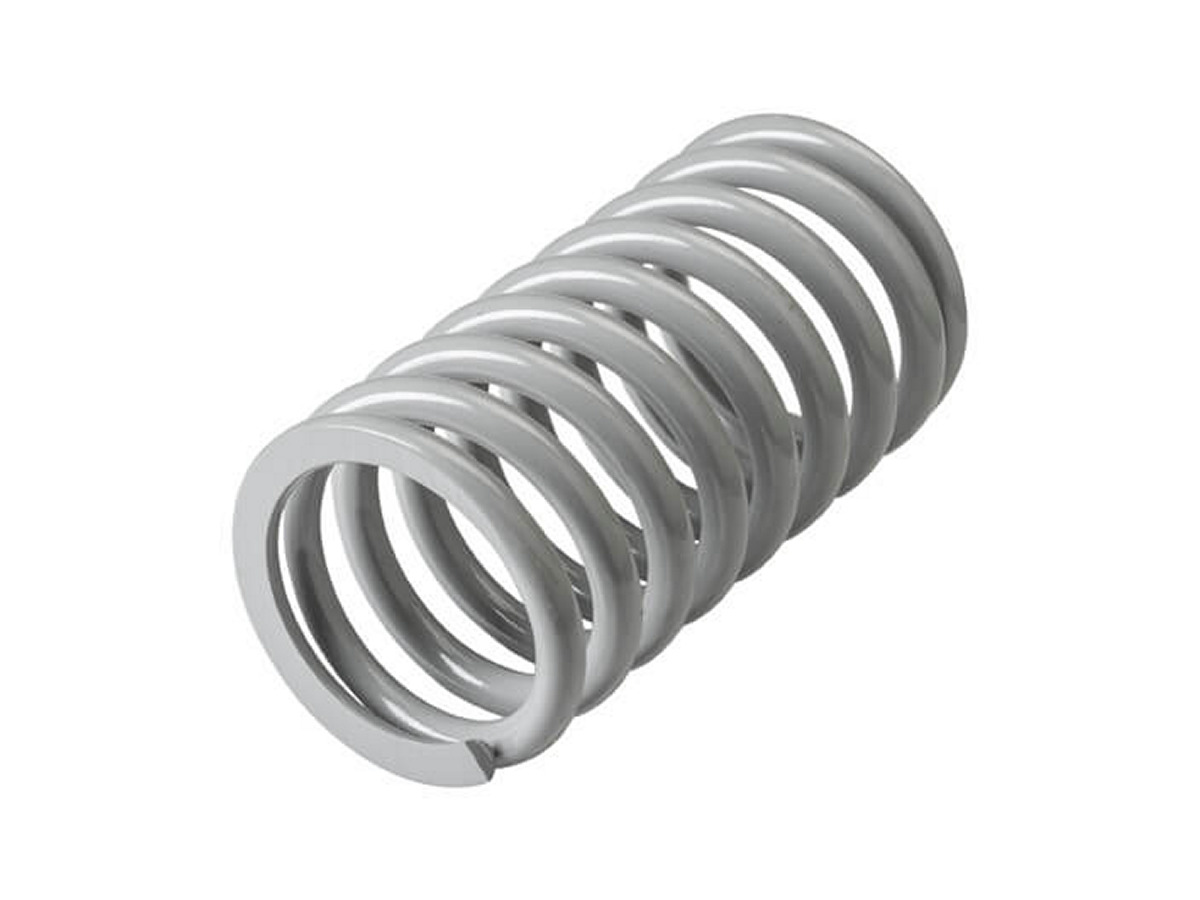
Compression Springs
A compression spring is an open-coil helical spring that resists a compressive load and pushes back as it is shortened. Its spring rate k = G·d⁴ / (8·D³·Nₐ) depends on the wire diameter d, mean coil diameter D, number of active coils Nₐ and the shear modulus G of the material. End type — closed and ground, closed or plain — changes seating, solid height and active coils.
Product Overview and Project Fit
Custom compression springs from 0.1–10 mm wire, including heavy duty, conical and ground-end designs. Send a drawing for spring rate, load and life review.
Custom compression springs for industrial equipment, automotive parts, switches, and OEM assemblies that require stable load and dimensional control.
- Various Specs
- Custom Ends
- High Durability
Applications
- Automotive
- Machinery
Processes
- Cold Coiling Process
- End Grinding
Compression spring design guide
Key dimensions
Compression spring drawings use these terms:
- d — wire diameter; OD and ID — outside and inside diameter; D = OD − d — mean coil diameter.
- L₀ — free length; L_s — solid height, with all coils touching.
- Nₜ — total coils; Nₐ — active coils, the ones free to deflect.
- C = D/d — spring index. About 4 to 12 is easy to coil; lower is stiff and highly stressed, higher tends to tangle and vary.
- Pitch — the distance between coil centres in the free state.
Spring rate and load
The rate of a round-wire compression spring is k = G·d⁴ / (8·D³·Nₐ), and the load at a deflection x is F = k·x (Hooke's law). Wire diameter dominates: doubling d makes the spring 16 times stiffer, while doubling D makes it 8 times softer.
Example: carbon spring steel, d = 2 mm, OD = 20 mm (D = 18 mm), 10 total coils with closed and ground ends (Nₐ = 8), G = 79.3 GPa: k ≈ 3.40 N/mm. At 10 mm deflection the load is about 34 N and the Wahl-corrected shear stress about 226 MPa.
End types
The ends set seating, active coils and solid height:
- Closed and ground — flat, square seating; Nₐ = Nₜ − 2; solid height ≈ Nₜ·d. The usual choice for industrial springs.
- Closed, not ground — lower cost; Nₐ = Nₜ − 2; solid height ≈ (Nₜ + 1)·d.
- Plain (open) — every coil active; Nₐ = Nₜ; poor seating.
- Plain and ground — Nₐ = Nₜ − 1; solid height ≈ Nₜ·d.
Stress, set and fatigue
Shear stress at the inside of the coil is τ = K_w·8·F·D / (π·d³), with the Wahl factor K_w = (4C − 1)/(4C − 4) + 0.615/C. Check stress at solid height, not only at the working length: if the spring can be compressed solid in assembly or service, it must survive that stress without taking a set.
Presetting (compressing the spring past its working range once or several times after coiling) raises the usable stress for static springs. Shot peening puts the wire surface into compression and is the main step for springs that must survive millions of cycles.
Buckling, surge and special shapes
A spring with a free length more than about four times its mean diameter can buckle; guide it on a rod or in a bore with clearance for the diameter growth under load. High-speed springs can surge when the drive frequency approaches the spring's natural frequency.
Conical springs telescope to a solid height close to one or two wire diameters and give a rising rate. Variable-pitch and barrel springs also give a progressive rate and help damp surge.
What to specify for a custom compression spring
Send these with the drawing or sample:
- Load at one or two working lengths, with tolerance (rate as reference).
- Free length, maximum solid height and the bore or rod it works in (maximum OD, minimum ID).
- Wire material, end type and finish.
- Operating temperature, environment and cycle life.
- Quantity per batch and per year.
Drawing inputs to confirm
Use these family-specific inputs to prepare a drawing review covering geometry, service conditions and acceptance. Final parameters are agreed for your project.
- Wire or bar diameter, outside/inside diameter and end geometry
- Free, working and solid heights; force at defined compression points
- Material, end grinding, duty cycles and inspection tolerances
FAQ
How do I calculate the spring rate of a compression spring?
Use k = G·d⁴ / (8·D³·Nₐ). For example, 2 mm steel wire (G ≈ 79.3 GPa), a 20 mm outside diameter (D = 18 mm) and 8 active coils give about 3.4 N/mm. The free Wanjin spring rate calculator also estimates load, Wahl-corrected stress and solid height.
What is the solid height of a compression spring?
Solid height is the length of the spring when every coil touches. For closed and ground ends it is about the total number of coils times the wire diameter; for closed ends that are not ground, add about one more wire diameter. The working length should stay above solid height with a margin, typically so that no more than about 80–85% of the available travel is used.
How do I stop a compression spring from buckling?
Springs whose free length is more than about four times the mean coil diameter can buckle sideways under load. Guide them on a rod or in a bore, grind the ends square and seat them on parallel surfaces, or split one long spring into shorter springs in series.
Should I specify spring rate or load on a drawing?
Specify the load at one or two working lengths, with a tolerance, and give rate only as a reference. Loads at defined lengths are what the assembly needs and what the spring maker measures, so they make inspection and approval clear.
Related Articles and Selection Guides
Contact Us
Share your drawing, working load, material and quantity. We will help define the next step toward a manufacturable spring.