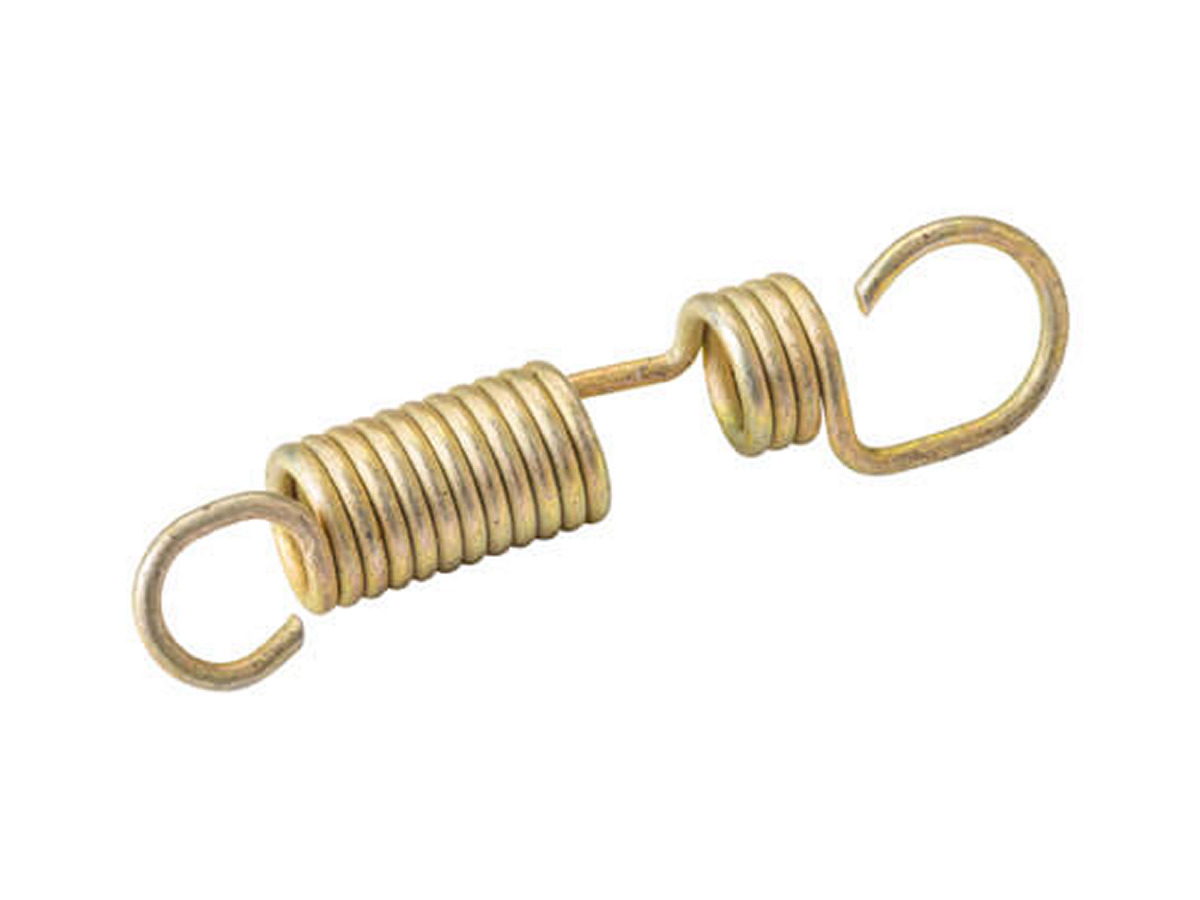
Extension Springs
An extension spring is a close-wound helical spring that resists pulling. Most extension springs are wound with initial tension, so a force must be applied before the coils separate; after that, the force rises with the spring rate. Hooks or loops transmit the load and are often the most highly stressed area, so end geometry is reviewed with the body.
Product Overview and Project Fit
Custom extension (tension) springs with machine, crossover or extended hooks and loops, with initial tension specified for your assembly.
Custom extension springs with loop or hook ends for axial tension applications in machinery, industrial doors, and mechanical return systems.
- Custom Hooks
- Resilience
- Anti-rust
Applications
- Machinery
- Automotive
Processes
- Cold Coiling Process
- Surface
Extension spring design guide
Load, rate and initial tension
A close-wound extension spring needs a certain force — the initial tension Fᵢ — before its coils separate. After that the load rises with the rate: F = Fᵢ + k·x. Initial tension is set during coiling and is easiest to achieve at a moderate spring index; very high or very low initial tension for a given index is hard to hold consistently.
The rate uses the same formula as a compression spring, k = G·d⁴ / (8·D³·Nₐ). Hooks add a little flexibility, and a common estimate is Nₐ = N_body + G/E.
Example: steel wire d = 1.5 mm, OD = 12 mm (D = 10.5 mm), 20 body coils, G = 79.3 GPa, E = 206 GPa: Nₐ ≈ 20.4 and k ≈ 2.13 N/mm. With 5 N initial tension the load at 15 mm extension is about 37 N.
Hook and end types
The end is chosen for the mounting and for stress at the bend:
- Machine hook or full loop — bent up from the last coil; the most common and lowest cost.
- Crossover centre hook — the loop crosses to the spring centre for a centred load line.
- Side hook or extended hook — reaches a mounting point beside or away from the body.
- Reduced or tapered end — coils taper before the hook, lowering stress at the bend.
- Threaded plug or swivel end — screwed into the coils for high-cycle or adjustable mounting.
Where extension springs fail
The hook bend carries bending stress where it leaves the body and torsional stress where it turns, so it is usually more highly stressed than the coils. A tight inside bend radius, nicks from forming tools and side loading all shorten life.
Specify the hook orientation, the hook opening and any limits on hook position, and ask for the bend radius to be reviewed with the body stress. For high-cycle duty, shot peening and stress relief after forming help.
Safety and maximum extension
Unlike a compression spring, an extension spring has no solid height to stop it. Define the maximum extended length the mechanism allows, check the stress there, and add a stop if the spring could be overstretched in service or assembly.
Where a broken spring must not release the load — for example on a door or guard — a drawbar spring keeps the parts linked even if the spring fails.
What to specify for a custom extension spring
Send these with the drawing or sample:
- Load at two extended lengths (inside hook to inside hook), or load at one length plus initial tension.
- Free length inside hooks, maximum OD and the maximum extended length.
- Hook type, opening and relative orientation of the two ends.
- Wire material, finish, temperature and cycle life.
- Quantity per batch and per year.
Drawing inputs to confirm
Use these family-specific inputs to prepare a drawing review covering geometry, service conditions and acceptance. Final parameters are agreed for your project.
- Wire diameter, body dimensions and hook/end geometry
- Initial tension and force at specified working lengths
- Hook orientation, installation clearance, cycle duty and finish
FAQ
What is initial tension in an extension spring?
Initial tension is the internal force wound into a close-coiled extension spring. The spring does not extend until the applied load exceeds it. It is specified with the load at a given extended length and is controlled by coiling settings, spring index and material.
How do you measure the length of an extension spring?
Free length is measured from the inside of one hook or loop to the inside of the other, because that is where the load is applied. Specify loads at extended lengths measured the same way, inside hook to inside hook.
Why do extension spring hooks break?
Most extension springs fail at the hook, not the body. The bend where the hook leaves the body carries combined bending and torsion stress, raised further by a tight bend radius or tool marks. Larger bend radii, reduced-diameter or crossover hooks, threaded plugs and shot peening all reduce the risk.
What happens if an extension spring is overstretched?
An extension spring has no solid stop, so it can be pulled past its elastic limit and take a permanent set or break. Where failure would be unsafe, add a mechanical stop or use a drawbar spring, which turns a compression spring into an extension unit that stays captive if the spring breaks.
Related Articles and Selection Guides
Contact Us
Share your drawing, working load, material and quantity. We will help define the next step toward a manufacturable spring.