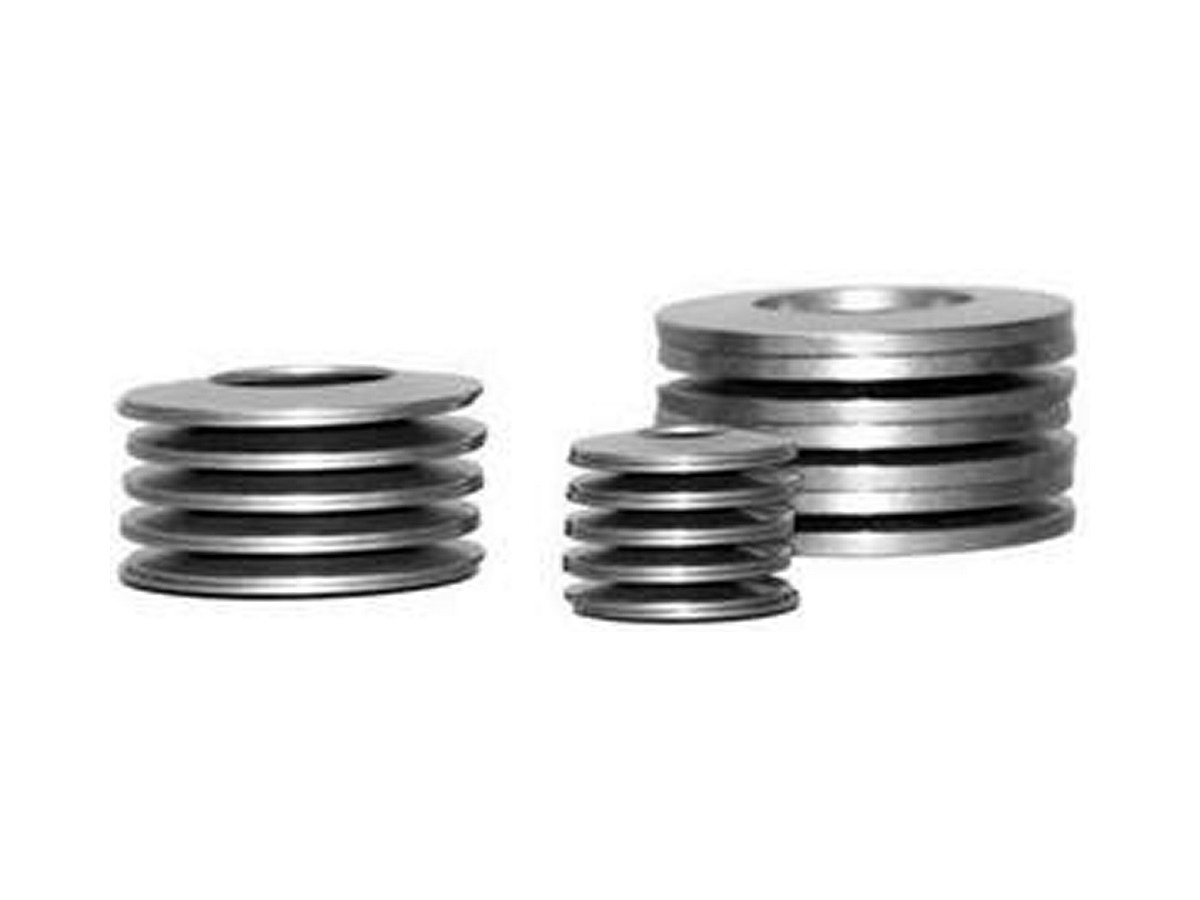
Belleville Spring Washers & Disc Springs
A disc spring, also called a Belleville washer or Belleville spring, is a conical annular disc that flattens under axial load. It carries high loads over small deflections, and its load–deflection curve can be tuned by the height-to-thickness ratio and by stacking discs in series or parallel. DIN 2093 / EN 16983 define common standard dimensions.
Product Overview and Project Fit
Disc springs (Belleville washers) for high load in a short stroke: clamping, bolted joints, valves and power equipment. Size, load and stacking reviewed.
Disc springs for high-load, short-stroke applications in clamping, buffering, power equipment, and heavy-duty mechanical assemblies.
- High Load
- Long Life
- Compact
Applications
- Power Industry
- Heavy Ind.
Processes
- Load Testing
- Testing
Belleville washer (disc spring) engineering guide
How a Belleville washer works
A Belleville washer is a coned annular disc. An axial load pushes the cone toward flat, and the disc resists through bending and tangential stress around its circumference. Because the material works in this conical shape, one disc can carry a large load over a deflection of only a fraction of its thickness — far less height than a coil spring of the same load.
The shape of the load–deflection curve is set mainly by the ratio of free cone height h₀ to thickness t. At about h₀/t = 0.4 the curve is nearly linear. As h₀/t rises toward about 1.4 the curve flattens near the flat position, so the load changes little with deflection — useful for holding bolt preload as gaskets settle or parts wear. Above that ratio the curve can turn negative and the disc may snap through.
Key dimensions
Disc spring drawings and standards use the same symbols:
- De — outside diameter; Di — inside diameter. The diameter ratio δ = De/Di is usually close to 2.
- t — material thickness (t′ is the reduced thickness of Group 3 discs with contact flats).
- l₀ — free overall height; h₀ = l₀ − t — free cone height.
- s — deflection; s = h₀ is the flattened position.
DIN 2093 / EN 16983 series and groups
Standard disc springs are listed in DIN 2093, now published as EN 16983, in three series of different slenderness:
- Series A — De/t ≈ 18, h₀/t ≈ 0.4: stiff discs for the highest load.
- Series B — De/t ≈ 28, h₀/t ≈ 0.75: medium load.
- Series C — De/t ≈ 40, h₀/t ≈ 1.3: thin discs with a flatter load curve.
- Manufacturing groups by thickness — Group 1: t below 1.25 mm; Group 2: 1.25–6 mm; Group 3: over 6 mm up to 14 mm, with small contact flats at the load points and a reduced thickness t′.
Belleville washer load formula
For a disc without contact flats, the load F at deflection s follows the Almen–László relation used in DIN 2092 / EN 16984: F = [4E / (1 − μ²)] · [t⁴ / (K₁·De²)] · (s/t) · [(h₀/t − s/t)·(h₀/t − s/(2t)) + 1].
Here E is the elastic modulus (about 206,000 MPa for spring steel), μ is Poisson’s ratio (0.3), δ = De/Di and K₁ = (1/π)·[(δ − 1)/δ]² / [(δ + 1)/(δ − 1) − 2/ln δ]. At the flattened position (s = h₀) the formula reduces to F = [4E / (1 − μ²)] · t³·h₀ / (K₁·De²).
Example: a DIN 2093 A 40 disc (De = 40 mm, Di = 20.4 mm, t = 2.25 mm, h₀ = 0.9 mm) gives K₁ ≈ 0.686 and about 6.5 kN at s = 0.75·h₀. For dynamic service the same standard gives stress formulas for the critical edges, which are checked against the DIN 2093 fatigue diagrams.
Stacking: series, parallel and combined
Discs stacked in series (alternately facing) multiply deflection at the same load: i discs in series give i times the deflection of one disc. Discs nested in parallel (same direction) multiply load at the same deflection: n discs give about n times the load, plus friction between the discs that adds hysteresis. Combined stacks put parallel sets in series.
Long stacks need a guide rod or sleeve with clearance and hardened contact faces, and are usually kept no longer than about three times the outside diameter so that every disc deflects evenly.
Disc spring materials
Grade, hardness, shot peening and corrosion protection are confirmed against each drawing and operating environment:
- 51CrV4 (50CrV4, 1.8159) chromium-vanadium spring steel — the usual choice for Group 2 and Group 3 discs.
- C75S (1.1248) carbon spring steel — common for thin Group 1 discs.
- 1.4310 (301/302) and 17-7PH (1.4568) stainless steel — corrosion resistance at lower stress.
- Nickel alloys such as Inconel 718 or X-750 — high-temperature service.
Where Belleville washers are used
Disc springs suit high force in short travel:
- Bolted joints that must stay preloaded through gasket creep, vibration or thermal cycling.
- Circuit-breaker operating mechanisms, switchgear and other power equipment.
- Valve actuators and safety valves.
- Machine-tool spindle drawbars and clamping fixtures.
- Clutch and brake packs, bearing preload and compact heavy-duty buffers.
Drawing inputs to confirm
Use these family-specific inputs to prepare a drawing review covering geometry, service conditions and acceptance. Final parameters are agreed for your project.
- Outside/inside diameter, thickness and cone height
- Working height and load points; series/parallel stack arrangement where applicable
- Guide clearance, installation direction, lubrication and acceptance method
FAQ
Is a disc spring the same as a Belleville washer?
Yes. "Disc spring", "Belleville washer", "Belleville spring" and "disc spring washer" describe the same conical spring washer. Unlike a flat or split washer, it is designed to deliver a defined spring load at a defined deflection.
What is a Belleville washer used for?
A Belleville washer supplies a high, defined force in a very short space. Typical uses are keeping bolted joints preloaded as gaskets settle or parts expand, loading valve and circuit-breaker mechanisms, clamping machine-tool spindles and tools, preloading bearings and building compact heavy-duty buffers from stacks of discs.
How much load can a Belleville washer handle?
It depends on diameter, thickness and cone height. A DIN 2093 size A 40 disc (40 mm outside diameter, 2.25 mm thick) carries about 6.5 kN at 75% of its cone height, and large Series A discs exceed 100 kN. Stacking discs in parallel multiplies the load; the exact figure comes from the DIN 2092 / EN 16984 load formula and is checked by load testing.
Related Articles and Selection Guides
Contact Us
Share your drawing, working load, material and quantity. We will help define the next step toward a manufacturable spring.