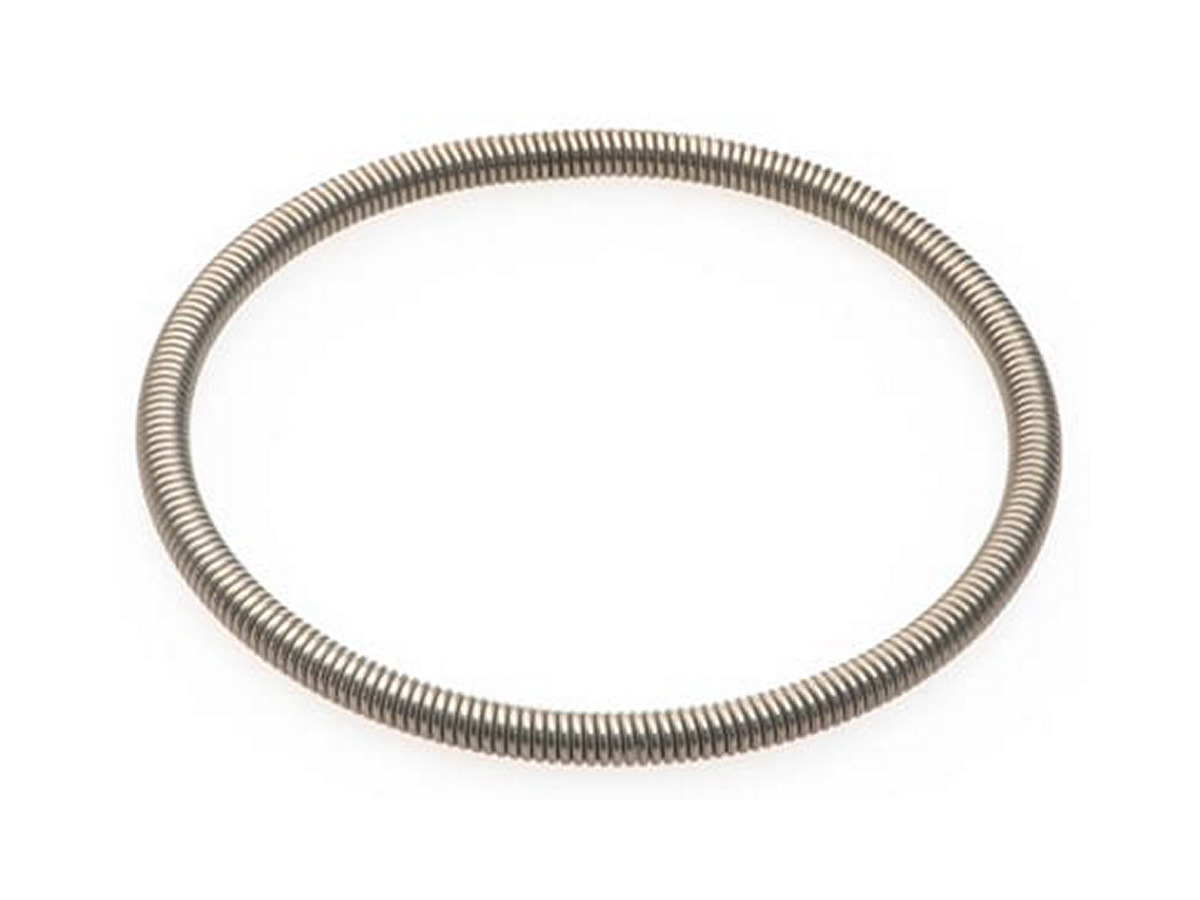
Garter Springs
A garter spring is a long close-coiled spring joined end to end to form a ring. It applies a uniform radial force — for example pressing an oil-seal lip onto a shaft — or holds segmented parts together.
Product Overview and Project Fit
Garter springs for oil seals, shaft seals and radial preload, joined into a ring for uniform force. Diameter, joint and tension reviewed per application.
Coiled into a circular form for sealing preload, connection compensation, and elastic retention in rotating or cylindrical assemblies.
- Resilience
- High Durability
- High Precision
Applications
- Automotive
- Machinery
Processes
- Cold Coiling Process
- Surface
Garter spring design notes
How garter spring force is set
A garter spring is a close-wound extension spring formed into a ring. Stretching the ring onto a shaft or seal increases its length, and the spring tension produces a uniform radial pressure. The force depends on the wire diameter, coil diameter, initial tension and how far the ring is stretched from its free diameter.
What to specify for a custom garter spring
Send these with the drawing or seal design:
- Free ring diameter (inside or centreline) and installed diameter.
- Radial force or tension at the installed diameter.
- Wire diameter, coil outside diameter and joint type.
- Material — carbon spring steel or stainless steel 302/304/316 — and operating medium and temperature.
Drawing inputs to confirm
Use these family-specific inputs to prepare a drawing review covering geometry, service conditions and acceptance. Final parameters are agreed for your project.
- Wire diameter, coil body dimensions and ring diameter
- Connection method and installed extension or preload
- Mating geometry, environment and force/diameter acceptance
FAQ
What is a garter spring used for?
Its best-known use is inside a radial shaft seal (oil seal), where it presses the rubber lip evenly onto the shaft so the seal keeps working as the lip wears and heats. Garter springs also hold segmented carbon seals, bundle parts together and act as small couplings or belts.
How are the ends of a garter spring joined?
The two ends are joined by screwing a tapered end into the other end, by hooking one end into a loop on the other, or with a small connector. The joint must not catch on the part, and the closed ring diameter and tension are specified together.
What is the difference between extension and compression garter springs?
An extension garter spring is stretched around a part and pulls inward, as in an oil seal. A compression garter spring is fitted inside a bore or groove and pushes outward. Most garter springs are the extension type.
Related Articles and Selection Guides
Contact Us
Share your drawing, working load, material and quantity. We will help define the next step toward a manufacturable spring.