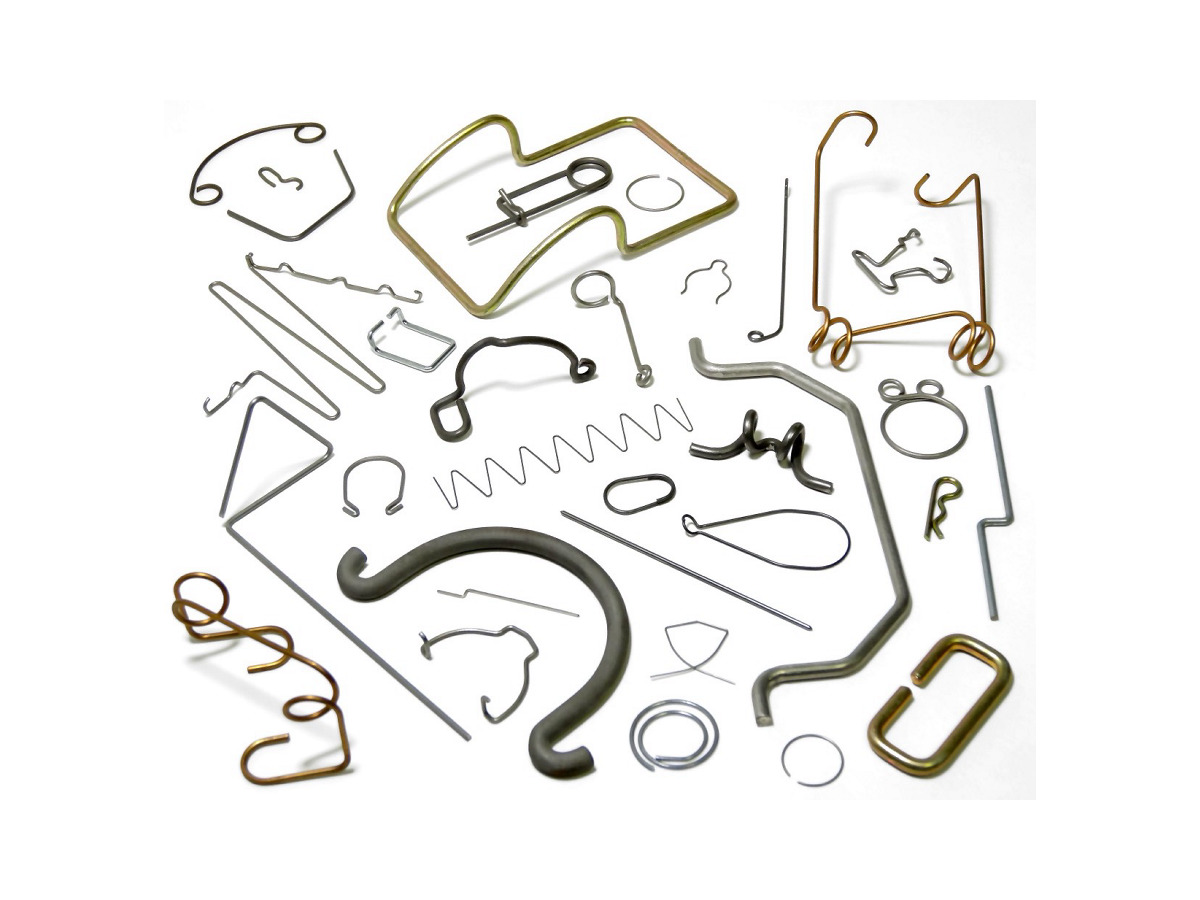
Custom Wire Forms & Wire Forming
A wire form is a part bent from spring or carbon wire into a functional shape — clips, hooks, brackets, levers or spring-loaded retainers — rather than a uniform coil. Bend radii, leg tolerances and the forming sequence determine whether the shape can be produced consistently.
Product Overview and Project Fit
Custom wire forms, clips and special-shaped springs from drawings or samples for OEM assemblies. Bends, material and tolerances reviewed before sampling.
Custom wire forms and special-shaped springs built from drawings or samples for non-standard geometries, assemblies, and OEM development projects.
- Complex Forms
- Blueprint Custom
- Special Alloy
Applications
- Machinery
- Power Industry
Processes
- Setup & Prototyping
- Testing
Wire forming design guide
What counts as a wire form
A wire form is any part shaped from wire that is not a plain helical spring: spring clips and hairpin clips, hooks and latches, brackets and handles, torsion-bar levers, retainers, guards and special-shaped springs that combine coils with bent legs. Many work as springs, others simply hold or locate parts.
How wire forms are made
The route depends on shape, wire size and volume:
- CNC wire bending — multi-axis machines straighten, feed, bend and cut in one cycle, with little dedicated tooling; suited to prototypes and production.
- Spring coilers with forming tools — for parts that combine coils with legs or loops.
- Fixtures and presses — for large wire, low volumes or bends a CNC bender cannot reach.
- Secondary operations — chamfering, flattening or coining, thread rolling, welding, stress relief, shot peening, plating or powder coating.
Design rules that keep wire forms consistent
Keep the inside bend radius at least equal to the wire diameter on spring-temper wire, leave straight length between bends for the bending head to grip, and avoid bends that close back on themselves where the tool cannot reach.
Put tight tolerances only on the features that matter in assembly. Wire springs back after each bend, so angles and leg lengths vary with material batch; datum features and gauge checks should reflect how the part is actually located.
Wire form materials
Material is chosen for spring function, strength and environment:
- Music wire and oil-tempered spring wire — clips and forms that must spring back.
- Stainless steel 302/304 and 316 — corrosion resistance, food and medical equipment.
- Low-carbon steel wire — non-spring brackets, guards and handles that are welded or coated.
- Phosphor bronze and beryllium copper — conductive clips and contacts.
What to send for a custom wire form
Send these with the drawing or sample:
- A dimensioned drawing (2D or 3D) or a physical sample.
- Wire material, diameter and finish.
- Critical dimensions and how the part is located in assembly.
- Load, deflection or retention force if the part works as a spring.
- Quantity per batch and per year.
Drawing inputs to confirm
Use these family-specific inputs to prepare a drawing review covering geometry, service conditions and acceptance. Final parameters are agreed for your project.
- Wire dimensions, 2D/3D datums and bend locations
- Critical contact points, assembly envelope and functional loads
- Drawing revision, tolerances and agreed checking fixture
FAQ
What do you need to quote a custom wire form?
A dimensioned drawing or sample, material and wire diameter, critical tolerances, finish, quantity and how the part is assembled or loaded. Physical samples help when tooling or bend order is unclear.
What is wire forming?
Wire forming is bending, cutting and shaping wire into a functional part — clips, hooks, brackets, handles, retainers or springs with special shapes. Most parts are made on CNC wire benders that feed, bend and cut in one cycle; secondary steps can add flattening, threading, welding, heat treatment and plating.
What is the minimum bend radius for a wire form?
As a rule of thumb, keep the inside bend radius at least equal to the wire diameter on spring-temper wire. Softer wire can be bent tighter, while harder wire and sharp bends risk cracking, so the radius is confirmed against the material and its temper.
Related Articles and Selection Guides
Contact Us
Share your drawing, working load, material and quantity. We will help define the next step toward a manufacturable spring.