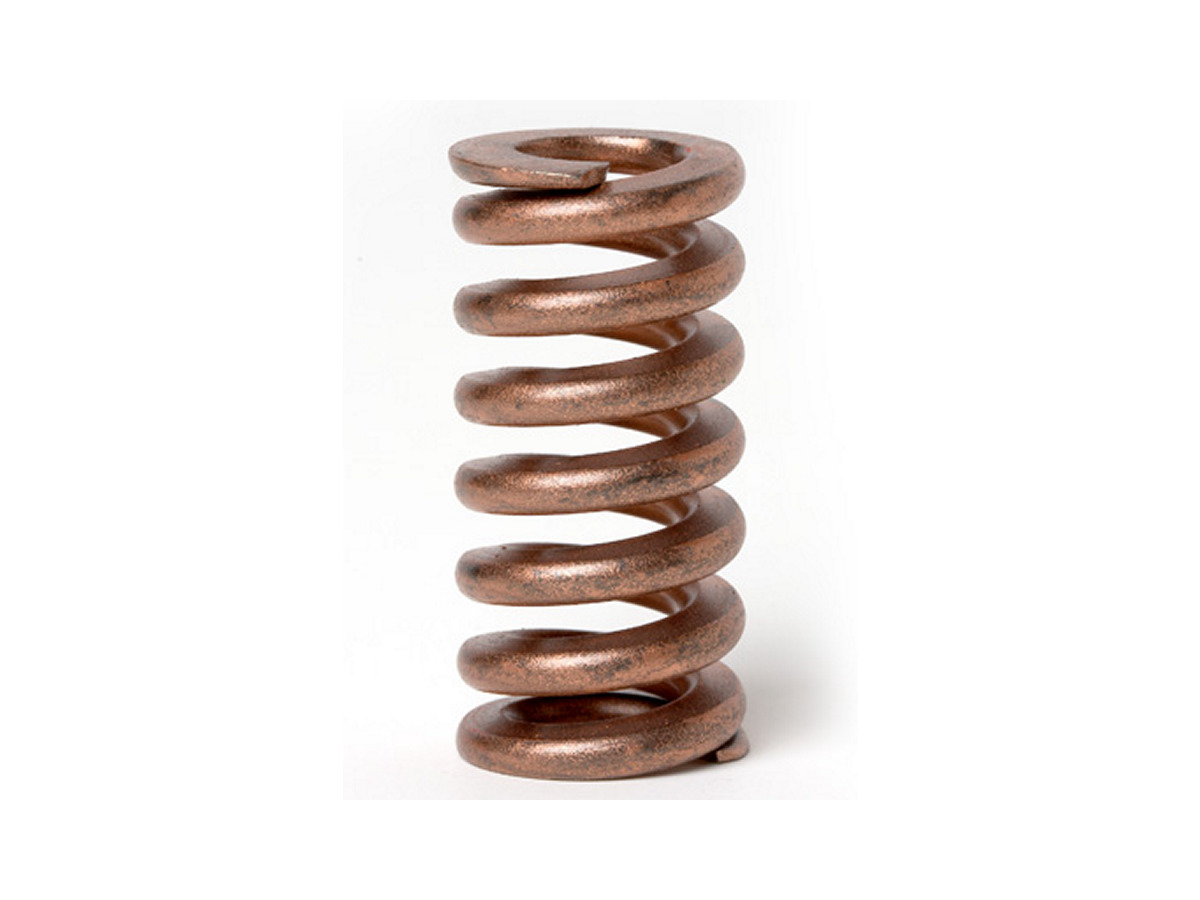
Die Springs
A die spring is a heavy duty compression spring wound from rectangular (flat-sided) wire. Compared with a round-wire spring of the same size, the rectangular section carries a higher load in a confined pocket, which is why die springs are used in stamping dies, injection molds and fixtures. Catalog die springs are usually color-coded by load class.
Product Overview and Project Fit
Custom die springs in rectangular wire for stamping dies, molds and heavy tooling. Load class, travel and fatigue life reviewed against your die drawing.
Rectangular section for stamping dies, high rigidity and durability.
- Rectangular
- Color Coded
- High Impact
Applications
- Machinery
- Heavy Ind.
Processes
- Cold Coiling Process
- Testing
Die spring selection guide
Why die springs use rectangular wire
A die spring is a heavy duty compression spring wound from rectangular or trapezoidal wire, usually chrome-vanadium or chrome-silicon steel with ground ends. For the same hole and rod diameter, the rectangular section stores more energy than round wire, so the spring carries a higher load in the small pocket of a stamping die, mould or fixture.
Catalogue die springs follow dimension standards — ISO 10243 in Europe and much of Asia, JIS-style series in Japan and North American series in the USA — so springs of the same hole size, rod size and length are interchangeable within a standard.
Colour codes and load classes
Colour identifies the load class only within a standard:
- ISO 10243: green — light load; blue — medium load; red — heavy load; yellow — extra heavy load.
- JIS-style (Japanese) series: yellow — extra light; blue — light; red — medium; green — heavy; brown — extra heavy.
- North American series use their own colours, so a yellow or green spring can be a light, heavy or extra heavy class depending on the source.
- Specify standard, class, hole diameter, rod diameter and free length rather than colour alone.
Deflection, preload and life
Die spring life depends mainly on how far the spring is compressed. Makers publish maximum deflection as a percentage of free length in columns for long life, average life and maximum deflection, and the allowed percentage falls as the load class rises. Production tooling should be designed to the long-life column.
Install the spring with some preload so it never fully unloads and does not chatter or shift in its pocket. Keep the total of preload and working stroke within the chosen deflection, and never let the spring reach solid height.
Installation in the die
Most early die spring failures come from installation:
- Guide the spring on a rod or in a bore with clearance for the diameter change under load.
- Seat it on flat, square, hardened surfaces; side loading and tilted pockets crack the end coils.
- Replace springs as a set so that the load stays balanced across the die.
- Keep chips and lubricant residue out of pockets and watch temperature in high-speed presses.
What to specify for custom die springs
Send these with the die drawing:
- Standard and load class, or the force needed at installed and working length.
- Hole and rod diameters, free length and available pocket depth.
- Preload, working stroke and press speed (strokes per minute).
- Expected life in cycles and operating temperature.
- Quantity per die set and per year.
Drawing inputs to confirm
Use these family-specific inputs to prepare a drawing review covering geometry, service conditions and acceptance. Final parameters are agreed for your project.
- Section geometry, outside diameter and installation envelope
- Free/working height, compression stroke and target cycle duty
- Matched series or standard and load acceptance; confirm colour coding for that series
FAQ
What is the difference between a die spring and a compression spring?
Both are compression springs. A die spring uses rectangular wire and is designed for high load and repeated cycling in die pockets, usually with ground ends and a defined maximum travel. A standard compression spring uses round wire and covers a wider range of loads, sizes and materials.
What do die spring colours mean?
The colour marks the load class within one standard. Under ISO 10243, green is light load, blue medium, red heavy and yellow extra heavy. Japanese JIS-style die springs run yellow, blue, red, green and brown from extra light to extra heavy. The same colour can therefore mean different loads, so always state the standard and class, not the colour alone.
How far can a die spring be compressed?
It depends on the load class and the life you need. Die spring makers publish maximum deflection as a percentage of free length, with a lower figure for long life; heavier classes allow less deflection. Design production dies to the long-life figure and never let the spring reach solid height.
Related Articles and Selection Guides
Contact Us
Share your drawing, working load, material and quantity. We will help define the next step toward a manufacturable spring.