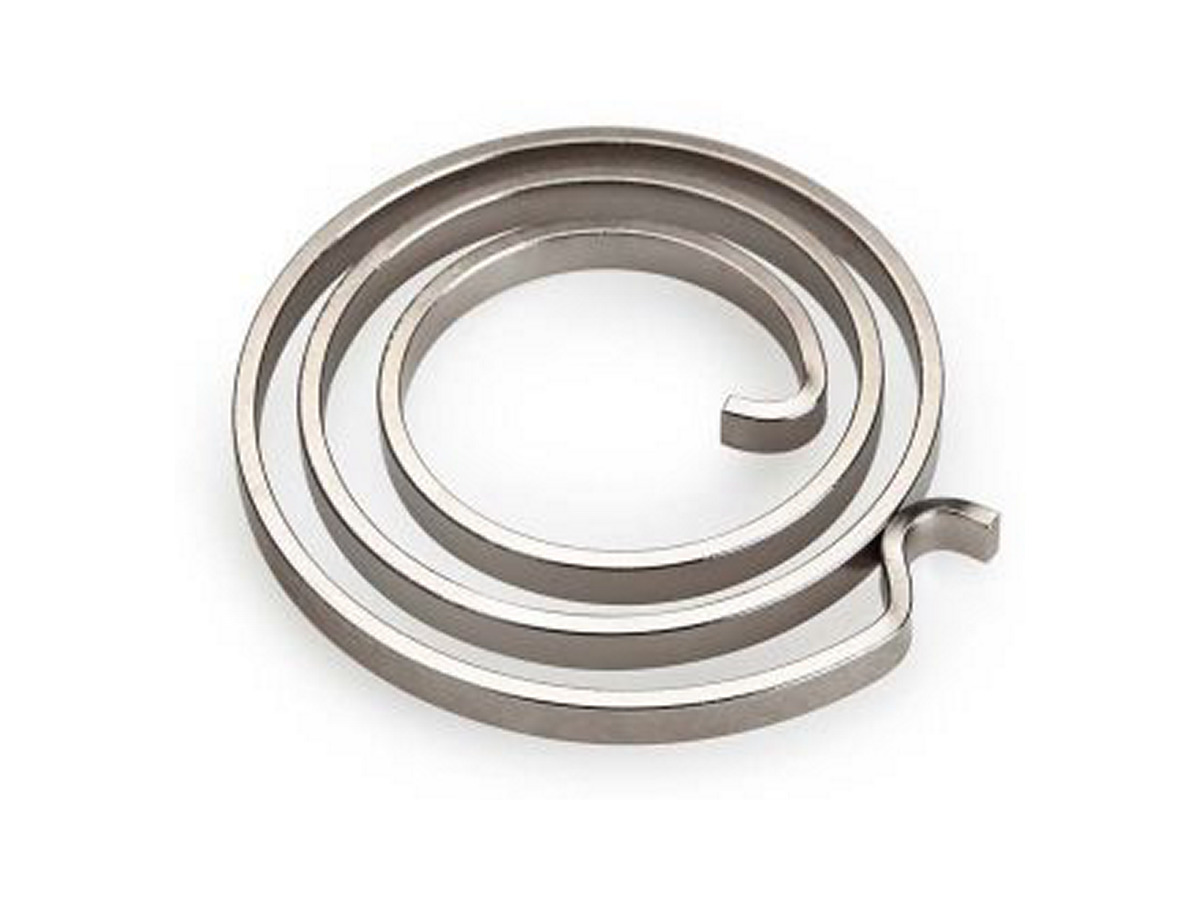
Spiral Springs
A spiral spring, or flat spiral torsion spring, is a strip wound in a plane with space between the coils. Rotating the inner end relative to the outer end produces torque over a limited angle, typically less than a few turns, for return and balancing functions.
Product Overview and Project Fit
Flat spiral springs from strip for rewind, energy storage and torque return in compact mechanisms. Strip size, turns and torque reviewed per drawing.
Flat spiral springs formed from strip material, suitable for rewind, energy storage, travel limiting, and compact transmission mechanisms.
- Long Life
- Compact
- Stable Torque
Applications
- Machinery
- Electronics
Processes
- Cold Coiling Process
- Testing
Spiral spring design notes
Spiral spring torque
Because the coils do not touch, a spiral spring has an almost linear torque–angle curve and little friction, unlike a power spring wound inside a case. Torque rises with strip width and with the cube of strip thickness, and falls with the active length of the strip.
The inner end is usually fixed to an arbor slot or hook and the outer end to a pin or tab. Specify torque at one or two angles, the rotation range, arbor diameter, outer envelope, strip material and finish.
Drawing inputs to confirm
Use these family-specific inputs to prepare a drawing review covering geometry, service conditions and acceptance. Final parameters are agreed for your project.
- Strip dimensions, coil envelope and shaft/housing end connections
- Winding direction, working turns and torque-versus-angle curve
- Installation preload, cycle duty and torque acceptance points
FAQ
What is a spiral spring?
A spiral spring, or flat spiral torsion spring, is a strip wound in a flat spiral with space between the coils. Holding the outer end and turning the inner end produces a return torque over a limited angle, usually less than a few turns.
Where are spiral springs used?
Spiral springs return knobs, gauges, dampers, hinges and latches to a rest position, balance small rotating parts and keep slight torque on instruments. A balance spring in a mechanical watch is a very fine spiral spring.
Related Articles and Selection Guides
Contact Us
Share your drawing, working load, material and quantity. We will help define the next step toward a manufacturable spring.